Salmon-in-Schools
The Connecticut River Salmon Association (“CRSA”) operates its Salmon-in-Schools program in many Connecticut public and private schools, providing a practical and enriching learning experience enjoyed by children from kindergarten through high school. Students actively participate in all phases of the program, from rearing fertilized salmon eggs in the classroom to stocking rivers. Lessons specific to environmental conservation, ecology, biology, and water quality can be integrated into existing school curricula, and the program aligns with all three dimensions of the Next Generation Science Standards (NGSS). For specific science standards alignment, see the “NGSS Correlations” section below. CRSA provides guidance and teacher education, technical assistance and reference materials, and links to the Connecticut Department of Energy and Environmental Protection (CTDEEP) resources. Participation in the program is free, other than purchasing the equipment as described below.
Registration for the new school year is open, and schools may register here: Program Registration Form (2026-2027).
Program Overview:
The Salmon-in-Schools Program currently operates in approximately 40 Connecticut schools. A number of these schools have multiple tanks in different classrooms and grade levels within their district. Teachers and students are responsible for tank maintenance, temperature control, and projecting rates of development for release in approved streams.
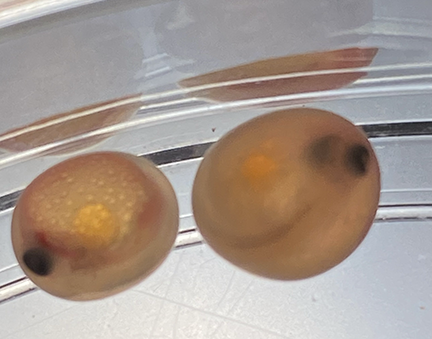
Fertilized Atlantic salmon eggs are delivered to schools in early January and incubated in chilled aquarium tanks in each classroom. These eggs will have been harvested from salmon that have previously returned to the Connecticut River. The breeding and egg harvesting process is conducted at CTDEEP’s Kensington Hatchery.
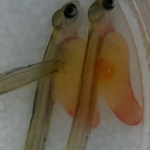
The eggs can be expected to hatch about mid-February into “alevin”, a small fish of about one to one and a half inches, supported by a yolk sac (the egg residual) on its stomach. The yolk sac is its sole source of food supply.
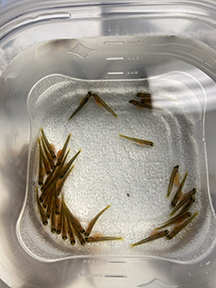
By the end of April or early May, the salmon are approaching the “fry” stage. The sac will be gone, and the fish look like a streamlined small minnow. The rate of fry developmentmust be carefully controlled throughout the incubation process by monitoring and adjusting the water temperature to ensure that the fry are at the proper developmental stage for release to streams on a pre-planned date.
Stocking:
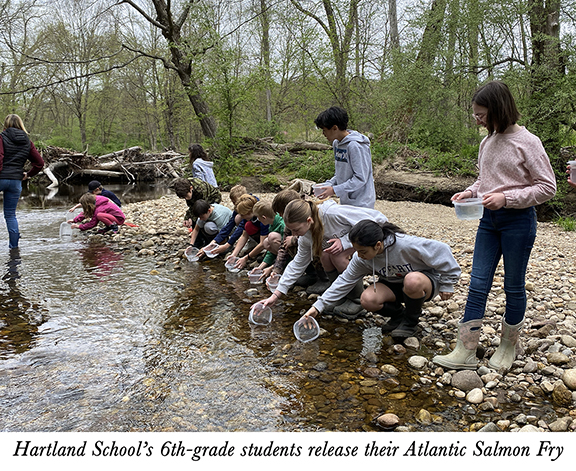
The fish are ready for stocking in a tributary of the Connecticut River by late April or early May, at a location pre-approved by the CTDEEP and CRSA. These fish must be released at the very beginning of the fry stage because they are about to exhaust the yolk sac’s food supply and must have access to natural food. In nature, wild salmon fry must emerge from the gravelly stream bottom at the same time that aquatic insects are also emerging after their winter hiatus—it is those insects on which the salmon fry feed. In the classroom, students must carefully simulate this timing. Stocked too soon, the fry would starve because there would be no food for them in Connecticut streams. Stocked too late, the fry will be close to starvation and will not survive.
Schools are responsible for planning their field trips and coordinating with CRSA for an approved stock-out location and date. Many schools spend at least several hours or most of the school day at the release site, doing a variety of educational (and fun) activities related to their curriculum. CRSA provides resources for lesson ideas, many of which are created and shared by other teachers in the program.
Equipment Costs:
The total investment required is approximately $1,600-$1,700. Most of that cost is the aquatic chiller, a critical piece of equipment, as temperatures in the 2-4 degrees Celsius range are required. CRSA has found that the most reliable one is manufactured by a California company and sold to educational institutions. Other materials include a 20-gallon high-wall tank, insulation, a pump and filter, an aquarium thermometer, and miscellaneous other items.
CRSA Support:
CRSA provides all new teachers with classroom posters, an equipment list, reference and educational materials, and training. We support all teachers during the program cycle as needed. A CRSA representative will deliver the eggs and, with new schools, assist with the stocking if requested. In addition, CRSA will have a specific liaison assigned to each school who is available for consultation, advice, and troubleshooting.
Educational Elements:
The Salmon-in-Schools program has been conducted in grade K-12 classrooms, all with success. It provides a unique window into the efforts to restore a spectacular species extirpated from the Connecticut River almost 200 years ago and now, through the Legacy Program, preserve the genetic integrity of the Connecticut River strain.
Students engage in all three dimensions of NGSS learning: science and engineering practices, disciplinary core ideas, and crosscutting concepts. As students raise salmon from eggs to fry and release them, they learn about life cycles, ecosystems, environmental stewardship, and conservation. Depending on grade level placement of the program, there are ample opportunities for enrichment in physical, life, and earth sciences. Some schools use the Salmon-in-Schools program as an interdisciplinary project, creating units encompassing STEM, English, and art classes.
See the NGSS Correlations page for more information about how the Salmon-in-Schools program can be used to address some NGSS Standards.
Program Risks:
Some incidental mortality among eggs and alevin can be expected in virtually all tanks. These major casualties, coming at the egg stage, could have been caused by a variety of factors: incipient disease, chlorine or other foreign substance introduction, damage in transit, etc. Unfortunately, CRSA cannot replace eggs once this program gets started. However, we do provide education about minimizing these risks and encourage all teachers (new and veteran) to attend training on an annual basis.
There is a risk of chiller failure due to equipment malfunction or power outages. CRSA provides specific recommendations for preparation in the event of power outages. All equipment should be set up at least one month before egg delivery to monitor function and practice temperature control. CRSA typically has a few spare chillers for emergency purposes.
Schedule:
- Late summer/early fall: Program Registration; CRSA to confirm participating schools
- Late summer/early fall: equipment ordered/purchased by participating schools.
- September: Registration for Teacher Orientation
- Mid-October: New Teacher Orientation (full day). Veteran teachers are encouraged to attend for ½ day.
- Late November (by Thanksgiving break); tank up and running, the teacher should be monitoring & controlling the temperature and teaching students how to keep records.
- Early January – egg delivery.
- Late January to mid-February: hatching.
- March: Request and confirm preferred stock-out date (rain or shine), plan your field trip
- Mid April/Mid May: stocking.
- Late May: Complete the End-of-Year Stock Out report due
Looking for more information about the program? Check out these recent articles in Estuary Magazine:
Below the Surface: Giving Tanks for Aquatic Education, Estuary Magazine 2025